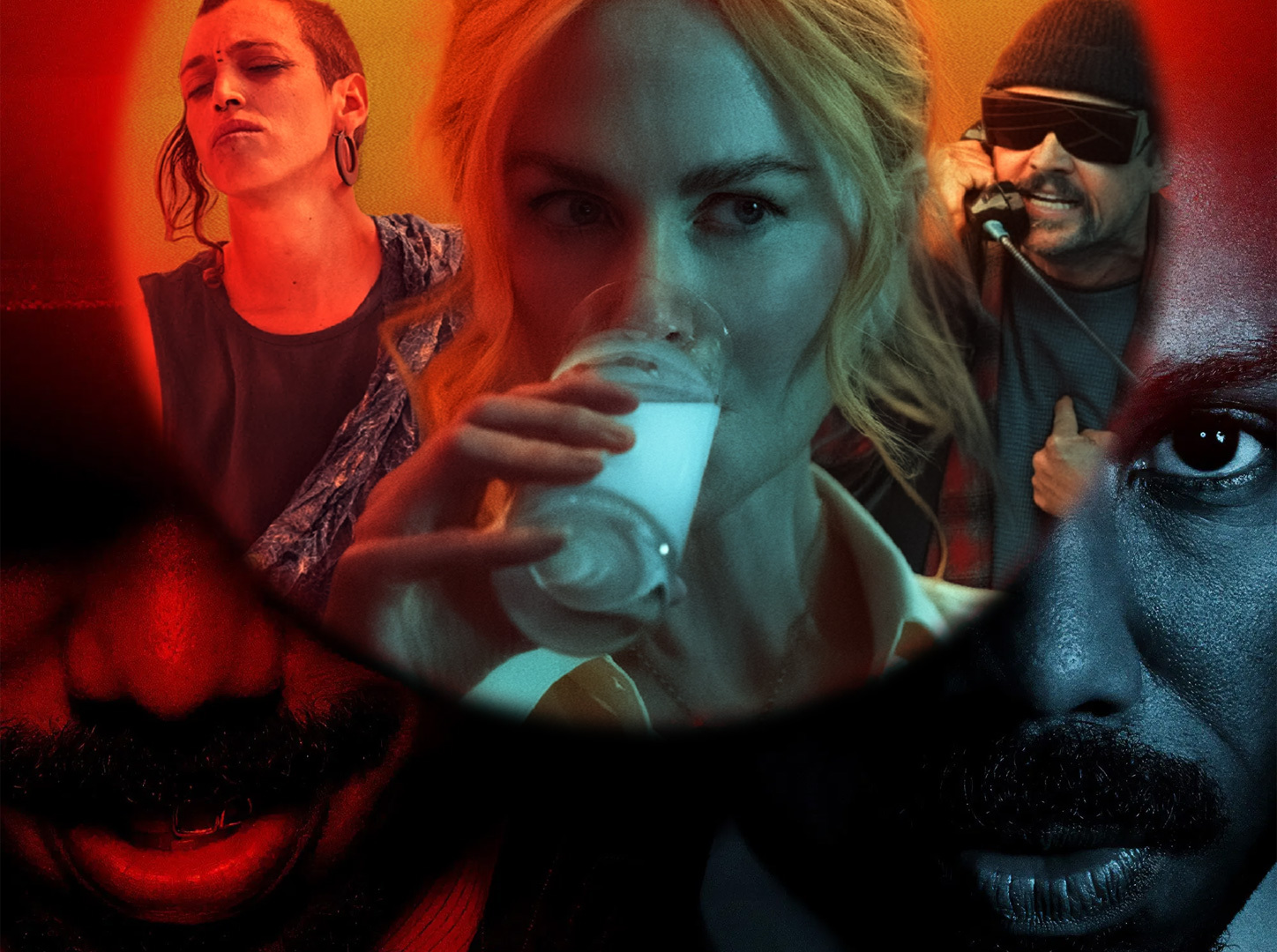
Join us for this countdown of our favourite 2025 movies, and find something to add to your watchlist.
Looking back on 2025, it’s been a year of excellent viewing, with perhaps the closest critical consensus you’re likely to get about its standouts. The top 20 for 2025, as selected by Flicks contributors, feels lighter on optimism than some previous years, it should be said. We’re always up for a challenge, but there’s a tone to many of this year’s picks that—utterly unsurprisingly—mirrors the ever-increasing friction and fucked up-ness of the world around us.
That’s not to say this is a bleak list, necessarily. And thankfully! Even within some of the more confronting reflections on ourselves you’ll find dollops of humour—often of the blackest kind, sure—plenty of pure entertainment, and surprising subtlety. One thing’s for sure: the best of the best grabbed hold of us and never let go, packing tonal shifts and other surprises, alternating moments of levity and clarity, and generally staying one step ahead of their awed audiences.
A highly subjective list? Well, of course it is. That’s what we wanted from the 16 writers who submitted picks, 88 films jockeying for position in this final top 20. Read on and see out where you agree or disagree with our faves, a list including movies we saw at film festivals, general cinema release or via streaming.
In putting this top twenty list together, our writers were asked for a list of at least ten movies, with 100 points to allocate across their picks (and a maximum of 40 points per film). With the resulting lists aggregated into one, this methodology allowed our writers to champion the movies in cinemas or on streaming this year that they felt most passionate about, and the results reflect a great year of movie-watching—with plenty of recommendations for readers.
Not all of these movies may technically be 2025 titles—but territorial release dates and film festival appearances mean that 2025 was when these films left their mark on us. Where possible, each entry quotes from Flicks coverage published when we saw them.
Best-of lists contributed by: Rachel Ashby, Amelia Berry, David Michael Brown, Luke Buckmaster, Dominic Corry, Rory Doherty, Adam Fresco, Vicci Ho, Annabel Kean, Clarisse Loughrey, Liam Maguren, Steve Newall, Amanda Jane Robinson, Stephen A Russell, Daniel Rutledge, Paul Scantlebury, Sarah Thomson and Aaron Yap.

20. Final Destination: Bloodlines


A beloved horror franchise returned after more than a decade with a new instalment—and a renewed enthusiasm for elaborate Rube Goldberg-like tableaux of terror in everyday settings.
In a feature focusing on the grisly head trauma inflicted onscreen over the duration of the series, Daniel Rutledge characterised the brutality: “This series delivers a purer joy than most horrors, leaning into the silliness without tipping into self-parody, and serving up bucketloads of gore without a hint of grimdark misery”

19. Resurrection

Resurrection (Kuang ye shi dai)
Bi Gan returned after wowing us with 2018’s Long Day’s Journey into Night, serving up something even more audacious (and that’s saying something) with this love letter to cinema history, dreams, and the individual senses.
‘I understood maybe 70% of what was going on here but was 100% immersed throughout Bi Gan’s colossal, kaleidoscopic anthology epic—a perfect ratio for a film wanting to relay the world of dreams. Woozily paced and sumptuously shot with a muscular production that mightily lifts its love for cinema history, this is an easy highlight of my festival,” enthused Liam Maguren.

18. Predators
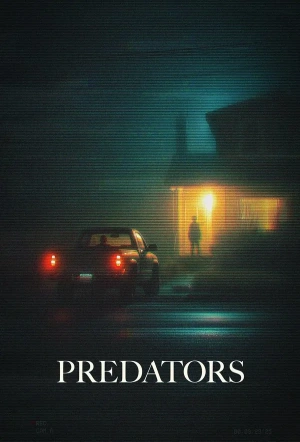
No, not those other, sci-fi Predators… The notorious American ‘reality’ show To Catch a Predator did, as its title implies, much more than observe, and this documentary digs into the ethics and actions of this hit show, one that made bank off the back of society’s fears and staged ‘gotcha!’ moments.
“Begins as a clear-eyed exploration of the notorious American television phenomenon, academically dissecting the horrific spectacle of justice as entertainment and interviewing many of those involved,” said Daniel Rutledge: “But it evolves unexpectedly into something deeper, something more personal and more provocative.”

17. Friendship


Tim Robinson’s acutely uncomfortable comedy has been ‘enjoyed’ in small doses—until now. It’s easy to see why Robinson’s Craig, an awkward and unlikeable suburban dad, is enamoured by a budding friendship with cool new neighbour Austin (Paul Rudd). However, things slide into concerning comedic territory…
“Friendship extracts a lot of strangeness and dread from its seemingly normal dramatic premise,” said Rory Doherty in a feature examining how both male leads have mined normality in different ways throughout their comedy. As Luke Buckmaster noted: “The film could be read as a spiritual successor to Ben Stiller’s The Cable Guy“.

16. If I Had Legs I’d Kick You

Rose Byrne grabs the audience’s attention in this stressful drama, as a psychologist with plenty of challenges of her own—a daughter with a a pediatric feeding disorder, a terrible therapist, a flooded house and an absent husband. There’s a hint of what to expect from writer-director Mary Bronstein’s prior work with spouse and frequent Safdie collaborator Ronald Bronstein (co-writer and co-editor of Good Time, Uncut Gems and Marty Supreme).
“Byrne’s performance, and the film itself, is paradoxically terrific: masterfully controlled and yet loaded with a volcanic instability,” Luke Buckmaster said: “It leaks and oozes from the screen; it creates its own wild energy.”

15. Wake Up Dead Man
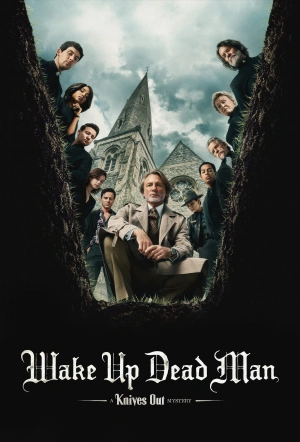
Wake Up Dead Man: A Knives Out Mystery

Going back to basics with his third Knives Out film, writer-director Rian Johnson serves up a classic locked-room mystery, augmented by musings on faith and the state of MAGA USA, and a movie star turn from Josh O’Connor. O’Connor’s pugilist priest leads a strong cast (Brolin, Close, Hayden Church, Scott, Spaeny, Washington, hell, even Renner’s good) with—of course—Daniel Craig’s Benoit Blanc swoopin’ in for sleuthin’.
“Johnson’s back-to-basics approach is the moral of the film in action,” said Amelia Berry: “Clarity, trust, hard work, and genuine emotion beat pompous pageantry six out of seven days of the week.”

14. Nickel Boys


Set in the 1960s and following two African-American boys sent to an abusive reform school in Florida, this dual Oscar nominee (for Best Picture and Best Adapted Screenplay) takes a unique approach. Shot from a first person point of view, we spend the duration of the film experiencing it from the perspective of its characters.
As Liam Maguren observed in his feature on the film, “At its most brilliant, Ross’s visual approach solidifies Nickel Boys’ most profound reminder: all these boys’ experiences, memories, and lives mattered.”

13. Train Dreams
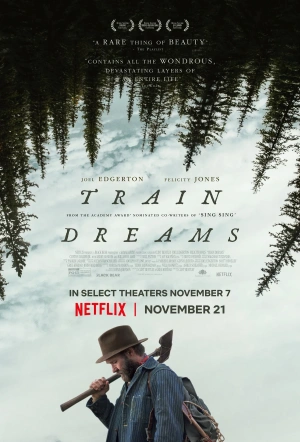
Acclaimed immediately on arrival as one of the year’s best, Train Dreams depicts the life of a railroad labourer (a highly praised Joel Edgerton) as it unfolds from the late 1800s and through the first half of the 20th century—humble work and lifestyle surrounded by unprecedented change.
“It doesn’t take long to see what all the fuss is about,” said Luke Buckmaster: “It’s a restrained, finely layered, melancholic portrait of an everyman, whose life is unremarkable but whose story, told with tenderness and care, is interesting partly because it exists in dialogue with those larger social and historical shifts unfolding around it.”

12. Guillermo del Toro’s Frankenstein
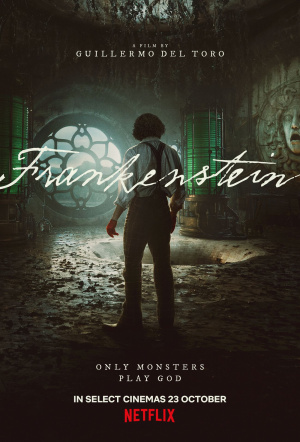
Guillermo del Toro's Frankenstein
Mary Shelley’s classic novel found a perfect-seeming fit in filmmaker Guillermo del Toro, who cast Oscar Isaac as the titular tortured scientist and Jacob Elordi as his ‘creation’. Wrapping its central thesis up in a glamorous, gothic production, Del Toro gets to the heart of this classic tale about what it really means to be human.
“This movie could be a savage, gory (and it is very gory) fantasy world of monsters, wild men, and gold-hearted women, but it is so much more emotional, intelligent and beautiful,” wrote Cat Woods.

11. Bring Her Back

The brothers behind horror smash Talk To Me returned with another slice of Australian scares. The great Sally Hawkins (Paddington, The Shape of Water) stars as Laura, a former social worker who takes in siblings Piper (Sora Wong) and Andy (Billy Barratt) as foster kids, but is managing her own familial trauma: the loss of her birth daughter. Oh, by dabbling in the demonic? Uh oh.
While emotionally affecting, it’s also visually confronting. As I put it in an interview feature with Danny and Michael Philippou: “The gore’s grunty, even for a seasoned horror fan (earning the film an R18 rating in Aotearoa and MA15+ in Australia), and the grief and emotion palpable.”

10. Misericordia

Stranger by the Lake director Alain Guiraudie got back into sexy thriller territory here (don’t worry if you’re squeamish—no unsimulated sex this time), patiently unfurling its narrative as a young man returns to a sleepy French village and stirs feelings, both good and bad.
“Sure, the pallid weirdo at the centre of the story seems to have no clear motivation for being such a leech, but who cares about that when you’ve got porcini mushrooms to pick and horny, lonely villagers to have dinner with?” mused Matthew Crawley.

9. The Weed Eaters
We were tickled by The Weed Eaters at its world premiere. Four holidaying friends encounter a strain of weed that prompts the most taboo of munchies in this resurgence of quality Kiwi DIY genre filmmaking. A strong example of a confident young creative Aotearoa, this stoner-comedy-horror succeeds through its authentic humour and character interplay. And, of course, its cannabis cannibalism…
As I said after the premiere, “I went into The Weed Eaters hoping for early-era Peter Jackson resource-stretching, dryballs Aotearoa humour and genre gross-out appreciation, and while it’s not as excessively gory as PJ, the pic paid off in spades.”
Note: While Weed Eaters writer-actor Annabel Kean contributed to our list, they recused themselves from voting for this film.

8. Bugonia
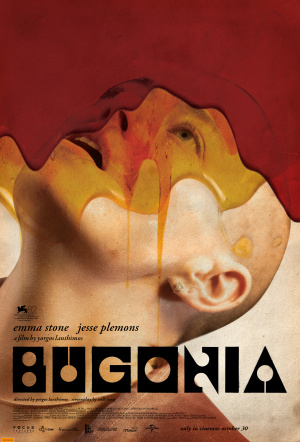
Convinced a pharmaceutical CEO (Emma Stone) is actually part of an alien invasion walking among us, a basement conspiracy theorist (Jesse Plemons) kidnaps her in a bid to save humanity. Jorgos Lanthimos’s fourth feature collaboration to date with Stone, Bugonia is also his take on 2003 Korean pic Save the Green Planet!, one that raises the ante with the calibre of its colliding actors, echoing our polarised present.
“We’re in a time right now where it’s very hard to hold two opposing truths at once,” Plemons told Rory Doherty: “It all has to be this or that, and if you’re with this school of thought, I’m with you, or you can get the fuck out of here.” Did Doherty find Emma Stone more positive? “When the parasite of humanity is inevitably extinguished, our planet will flourish, and that’s hopeful.” Hmm.

7. Eddington
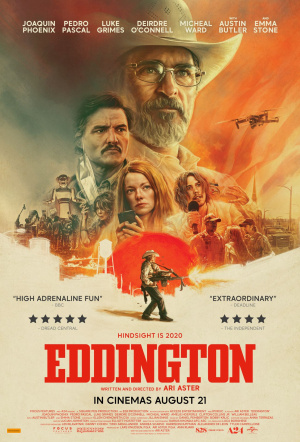
Perhaps the most overt examination of our polarised (recent) present on this list. COVID arrives in a small New Mexico town in Ari Aster’s uncomfortably familiar drama/satire/fever dream Eddington, its residents glued to their phones and stuck in their own bubbles of belief. It’s against this backdrop that a feud between Joaquin Phoenix’s sheriff and Pedro Pascal’s mayor escalates, and Aster again looks to literalise our fears.
“No viewpoint is spared being depicted as siloed here, and as this thing takes flight, the ways it departs from observable reality somehow capture something that resonates as even more real,” I said.
“We’ve become very, very paranoid,” Ari Aster explained to Rory Doherty. “We all know that something is really wrong. Things are changing very quickly, but we don’t agree on what that thing is.”

6. Babygirl

Sexy, smart, gripping (and funny when it wants to be), Halina Reijn’s Babygirl is a provocative modern take on the classic sex thriller. Nicole Kidman’s successful CEO may have an outwardly perfect life, but it’s one she puts in jeopardy when she has an affair with young intern Samuel (Harris Dickinson), setting in motion an intriguing exploration of shame and rebirth.
Cat Wood’s feature on the film notes “how vital Reijn’s movie is in enforcing a woman’s perspective in all its contradictory, confounding nuances.” Reinforced by what filmmaker Halina Reijn told me in our interview: “I always felt very lonely in my dark sexuality, and I thought as a woman that I wasn’t allowed to have masochistic fantasies, and I thought I was weak, and that was not feminist.”

5. It Was Just an Accident
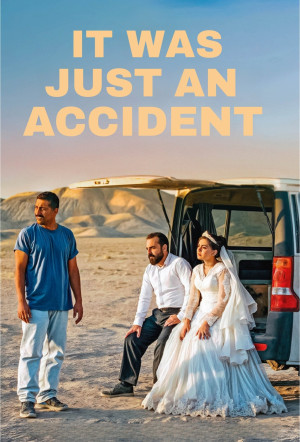
In this year’s Palme d’Or winner, a chance encounter brings a group of present-day Iranians into contact with their state-sanctioned tormentor (…or does it?). With his identity unclear, the uncertainty among the survivors fuels entertaining interplay and more than a hint of Coen caper.
“Equal parts tragedy and farce, Jafar Panahi’s […] story of revenge and justice in the face of political oppression by the Iranian regime is a surprisingly comedic, crowd-pleasing affair,” wrote Katie Parker: “The final 20 or so minutes, in which this levity gives way to the dread and horror that has been bubbling beneath are not so much a bait and switch as the revelation of something that was hiding in plain sight all along.”

4. Sirāt

Opening on a beautifully shot desert rave with a lovingly crafted audio mix to match, Sirât becomes a gripping journey across Morocco’s desert and mountains, places of transcendence and trauma as its best-left-unspoiled narrative unfurls. There’s a reason this pic appeared on so many Oscar shortlists this week.
“The first HOLY SHIT film of the festival for me,” enthused Matthew Crawley at NZIFF; “By far my favourite SFF experience this year,” declared Stephen A Russell from Sydney, while on the other side of the Tasman, I described the film as “superb” and recommended the big(gest) screen experience: “Seen as big and loud as possible, it stuns eyes, rattles ears and shakes nerves.”

3. Sinners

Defying box office gravity through positive word of mouth, bucking typical trends in Australasia by actually growing its audience after opening week, Ryan Coogler’s period vampire pic Sinners felt like a timely reminder of the pleasures of going to the movies. Starring dual Michael B. Jordans, foregrounding the power of music, and with a suitably fearsome fanged villain in Jack O’Connell, this cried out for a trip to cinemas—and moviegoers answered the call.
David Michael Brown called this “an audacious, ultra-violent, foot-tapping, high-kicking historical horror with two teeth in its neck and a twist in its tail,” in his feature on the film, adding: “Not only does Sinners uphold horrific vampiric expectations, it injects new blood into the perilous proceedings.”

2. Weapons

Zach Cregger’s follow-up to Barbarian is one of this year’s—this decade’s?—horror highlights. Set in a small town reeling from the aftermath of a whole classroom of students all disappearing one night (well, eerily, except one of them), it’s a film that balances drama, genuine scares, and a good dose of laughs, bolstered by Julia Garner, Josh Brolin, and Alden Ehrenreich’s performances.
“Weapons might just be a masterpiece,” wrote Tony Stamp, in a piece about how it’s tricky to discuss the film without spoiling it. “This is the power of watching a movie in a theatre, with other people who are as transfixed as you are,” he says later in the same feature: “At its best this communal fear, and then relief, can feel like magic.”

1. One Battle After Another
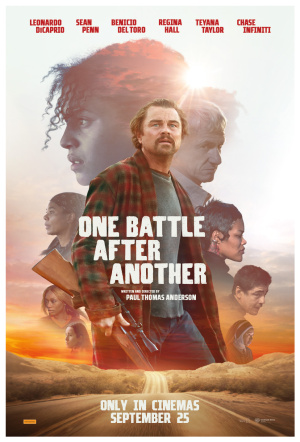
One of three Warner Bros. films at the top of our list this year, a scenario that looks much less likely under a future merged entity, One Battle After Another always felt destined for cinema’s highest accolade. (Yes, it has a probably Oscar-heavy future, but I actually meant winning this prestigious poll of Flicks writers).
Then again, ‘predictable’ is not shorthand for ‘undeserving’.
Drawing inspiration from Thomas Pynchon, Paul Thomas Anderson enlisted the likes of Leonardo DiCaprio, Teyana Taylor, Sean Penn and Benicio del Toro for an urgent, tense, and often hilarious action-thriller. Absurdist black comedy rubs shoulders with scenes ripped from tomorrow’s headlines as a former revolutionary and his daughter scramble to evade capture by domestic, white supremacist military forces.
“It is the funniest performance of the year,” said Rory Doherty of DiCaprio: “A welcome evolution of an unmissable trend in the A-lister’s career, playing sad sack losers whose stupidity and incompetence threatens to collapse their whole life.”
Still inducing goosebumps in me when I reflect on it, repeat visceral viewings confirmed this as a fierce reassertion of PTA’s filmmaking enthusiasm. The timing was immaculate as One Battle After Another‘s revolutionary fury and mocking satire of authoritarianism played out against all the awfulness of Trump 2.0.
And, it was a call to all of us not to lose that fire in our belly, to not get lazy and to never stop paying attention—whether you’re a stoned former revolutionary on the lam, a director staring down his own creative trajectory, or any of us getting complacent about what’s important to us.